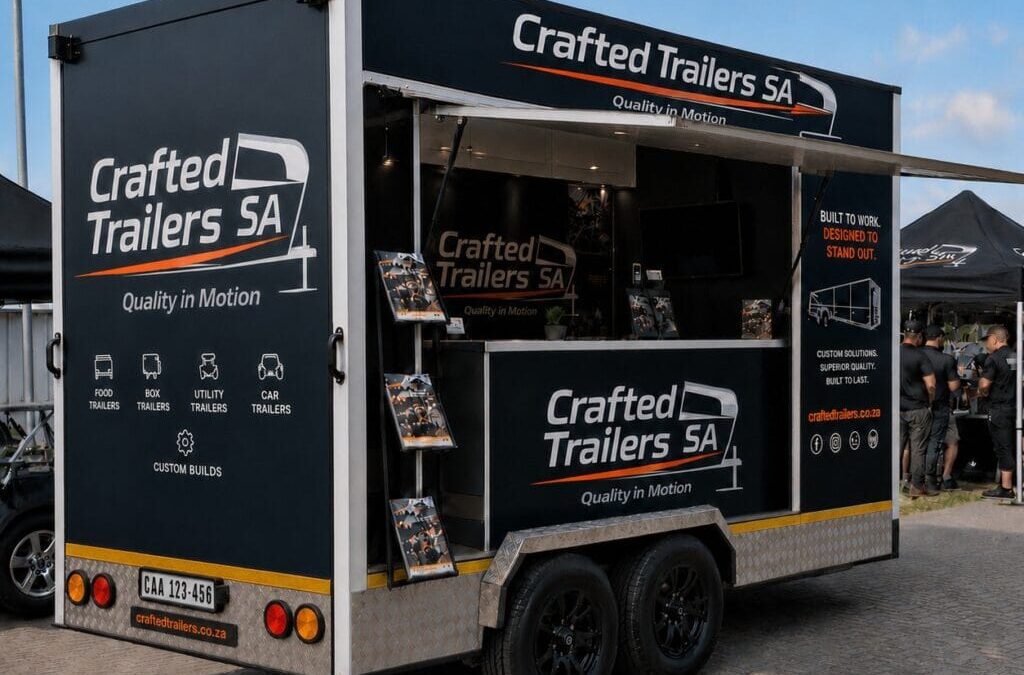
Food Trailer business startup in Cape Town? Learn about COA, trading permits, business licenses, trailer registration, gas certificates and food trailer compliance.
Starting a Food trailer business in Cape Town, the Western Cape or anywhere in South Africa is an exciting opportunity. A well-built food trailer gives you the freedom to take your food concept to markets, events, private functions, business parks and other trading locations.
Before you start trading, it is important to understand the paperwork and approvals that may apply. At Crafted Trailers SA we design and build custom food trailers that are practical, professional, and built with compliance in mind. In addition, we handle the trailer-related side of the process, including trailer road registration and licensing, gas compliance certificates, and electrical compliance certificates where applicable.
However, food business approvals are separate. These may include a Certificate of Acceptability, business license, informal trading permit, hawker permit, street trading permission, or municipal approval to sell food. Therefore, these approvals remain the responsibility of the business owner and the relevant authority.
Many people search for terms such as “food truck license” or “food truck Cape Town.” In most cases, however, they are actually looking for a towable food trailer built for mobile food trading.
This guide explains the key steps you should understand before launching a food trailer business in Cape Town or the Western Cape.
Step 1: Get Your Food Trailer Business License
A business license, sometimes called a trading license, may be required if your business sells or supplies meals or perishable food to the public.
In Cape Town, business license applications are handled through the City of Cape Town business license process. Furthermore, the Western Cape Government also provides general business license guidance for businesses that make or sell food that can spoil.
Requirements may vary depending on your business activity, trading location, and the type of food you plan to sell.
Typical application steps may include:
- Applying through your local municipality or the City of Cape Town business license process
- Providing your ID, business details, and supporting documents
- Confirming the type of food you plan to sell
- Confirming the trading address or area
- Allowing for any required inspections or checks by the relevant departments
Although Crafted Trailers SA does not apply for business licenses on behalf of customers, we can still help by building your trailer with practical compliance in mind. As a result, your trailer may be better prepared for future inspections and compliance checks.
Step 2: Apply for an Informal Trading Permit if Required
If you plan to sell food in a public space such as a street, pavement, beach area, municipal trading bay, or other informal trading area, you may need an informal trading permit or hawker permit.
Before operating in a public or municipal trading area, it is important to review the City of Cape Town’s informal trading permit application guidance.
Having a trailer does not automatically give you the right to trade in any location. Therefore, you may need to confirm:
- Whether trading is allowed in your chosen area
- Whether a trading bay is available
- Whether the area is managed by the municipality, a private owner, an event organizer, or a market operator
- What documents are required
- Whether food vendors are accepted
- Whether power, water, or waste rules apply
- Whether special event approval is required
While Crafted Trailers SA can advise you on the right questions to ask, we do not apply for informal trading permits, hawker permits, or street trading permissions on behalf of customers.
For this reason, always confirm trading permission before operating in a public space or managed trading area.
Step 3: Obtain a Certificate of Acceptability
A Certificate of Acceptability, often called a COA, is an important food safety approval for businesses that handle, prepare, store, transport, or sell food.
According to the City of Cape Town, anyone who wants to sell or hawk food in Cape Town may need to apply for a Certificate of Acceptability. In addition, the City provides both a COA application form and a COA FAQ guide for further detail.
A COA is linked to food hygiene requirements and is issued through the relevant Environmental Health authority. However, it is important to understand that a COA is not the same as a business license or permission to trade in a specific location.
The COA process may assess whether your food premises or mobile food setup is suitable from a hygiene and food safety perspective.
Common areas that may be checked include:
- Hand-wash facilities
- Utensil-wash facilities
- Suitable sinks
- Clean water supply
- Wastewater handling
- Food-safe internal surfaces
- Refrigeration where required
- Ventilation
- Lighting
- Pest control considerations
- Food storage
- General cleanliness and layout
Although Crafted Trailers SA does not apply for your COA or guarantee approval, we do build food trailers with practical COA considerations in mind. Consequently, your trailer can include suitable sinks, surfaces, plumbing, ventilation, lighting, and workspaces from the beginning instead of requiring costly changes later.
Step 4: Get Your Gas and Electrical Compliance Certificates
If your food trailer uses LP gas or electrical systems, proper installation and certification are important for safety, insurance, and inspection purposes.
Food trailers often include equipment such as:
- Gas fryers
- Gas burners
- Grills
- Bain-maries
- Coffee machines
- Refrigeration
- Lighting
- Plug points
- Pumps
- Extraction or ventilation systems
Crafted Trailers SA provides the required gas and electrical compliance certificates where applicable as part of the trailer build process.
This may include:
- Registered LP gas installation and gas compliance certification where applicable
- Certified electrical installation and electrical compliance certification where applicable
- Trailer-ready equipment layouts
- Safe appliance positioning
- Practical gas and power planning
For additional information, you can also refer to SAQCC Gas for registered gas practitioner details.
Importantly, these certificates relate to the trailer installation itself. Therefore, they are separate from food trading permits, business licenses, hawker permits, or COA approvals.
Step 5: Register and License Your Trailer
A food trailer is also a road-going trailer when it is towed on public roads. As a result, the trailer must be built and registered correctly for road use.
Crafted Trailers SA handles the trailer road registration and licensing process for the trailer itself.
This may include:
- Trailer road registration
- Trailer licensing
- VIN or trailer identification documentation
- Chassis documentation
- Lighting and reflector requirements
- Braking requirements where applicable
- License disc requirements
- Registration in the owner’s name
It is important to note that trailer road registration and licensing are separate from permission to sell food. In other words, road registration allows the trailer to be legally used on the road, but it does not automatically allow food trading in a public space, market, event, or municipal area.
Therefore, understanding this distinction is essential.
Step 6: Check Tax and VAT Requirements
When starting a food trailer business, you should also check your tax registration requirements.
Most businesses need to register for an income tax number. In addition, VAT registration depends on your taxable supplies and whether you meet SARS requirements.
From 1 April 2026, compulsory VAT registration applies once taxable supplies exceed R2.3 million over a consecutive 12-month period. However, you should always confirm the latest requirements with SARS or your accountant before trading.
Step 7: Check Other Permits and Requirements
Depending on your food concept, trading location, and business model, you may also need to consider additional requirements.
These may include:
- Fire safety requirements
- Food safety training
- Public liability insurance
- Event vendor approval
- Market vendor approval
- Landlord or property owner approval
- Waste management rules
- Water supply and wastewater handling
- Liquor licensing if alcohol is sold
- Signage or branding rules at specific venues
Not every business will need the same documents. For example, a coffee trailer operating at private events may have different requirements from a food trailer trading daily in a municipal area.
Therefore, always confirm requirements with the relevant authority, event organizer, market organizer, or property owner before trading.
Download the Food Trailer Permit Checklist
To make the process easier, we have created a practical Food Trailer Permit Checklist for the Western Cape and Cape Town.
Use it to keep track of business requirements, health and safety items, trailer road compliance, trading approvals and operational documents.
Download it here
Launch Your Food Trailer with Confidence
Starting a food trailer business can feel overwhelming at first. However, the right trailer build gives your business a stronger and more professional foundation.
Crafted Trailers SA assists with the trailer-related side of the process, including:
- Custom food trailer design
- Practical internal layout planning
- Equipment fitment
- Stainless-steel work surfaces
- Plumbing and water systems
- Gas compliance certificates where applicable
- Electrical compliance certificates where applicable
- Trailer road registration and licensing
- VIN and trailer documentation where applicable
- Branding and vinyl wrap options
- Professional finishing and signage
- Practical advice on what to ask your municipality, health office, or trading location
Although Crafted Trailers SA does not apply for food trading permits, business licenses, street trading permissions, hawker permits, or COA approvals on behalf of customers, we can still guide customers on common requirements and help prepare the trailer for practical compliance.
You bring the food concept and we will build the trailer.
FAQ: Food Trailer Permits, COA and Compliance in Cape Town
Do I need a Certificate of Acceptability for a food trailer in Cape Town?
If you sell or hawk food in Cape Town, you may need a Certificate of Acceptability (COA) from the City of Cape Town.
This certificate relates to food hygiene and food safety requirements. Therefore, you should always confirm the exact requirements with the City or your local Environmental Health office before trading.
Can Crafted Trailers SA apply for my COA?
No. Crafted Trailers SA does not apply for COA approvals on behalf of customers.
Instead, the business owner must apply through the relevant authority. However, we can still advise you on common requirements and build your trailer with practical compliance in mind.
Do I need an informal trading permit for a food trailer?
If you plan to trade in a public space, municipal trading area, or informal trading location, you may need an informal trading permit or hawker permit.
Requirements can vary depending on the location and local authority. Therefore, it is important to confirm the rules before operating.
Can I trade anywhere once I have a food trailer?
No. Owning a food trailer does not automatically give you permission to trade anywhere.
In many cases, you may still need approval from:
- The municipality
- A property owner
- A market organiser
- An event organiser
As a result, it is always important to confirm trading permission before operating.
Do you help with food trailer trading permits or business licenses?
Crafted Trailers SA does not apply for:
- Food trading permits
- Business licences
- Street trading permissions
- Hawker permits
- COA approvals
These applications must be handled by the business owner through the relevant authority.
However, we can still advise customers on common compliance questions and build trailers with practical compliance considerations in mind.
Do you register and license the trailer for road use?
Yes. Crafted Trailers SA handles the trailer road registration and licensing process for the trailer itself.
However, trailer licensing is separate from:
- Food trading permission
- COA approval
- Business licensing
- Municipal approval to sell food
Therefore, road registration does not automatically allow food trading.
Do food trailers need gas and electrical certificates?
Yes. If your trailer includes gas or electrical installations, certification is important for safety, inspections, and insurance purposes.
Where applicable, Crafted Trailers SA can provide:
- Gas compliance certificates
- Electrical compliance certificates
These certifications form part of the trailer build process where required.
Is roadworthy handled by Crafted Trailers SA?
Yes. Crafted Trailers SA builds and prepares trailers for road use.
In addition, we handle the trailer registration and licensing process for the trailer itself. However, this remains separate from permission to trade food.
Do you build food trailers in Cape Town?
Yes. Crafted Trailers SA builds custom food trailers for customers in Cape Town, the Western Cape, and across South Africa.
What types of food trailers do you build?
We build a wide range of custom food trailers, including:
- Coffee trailers
- Burger trailers
- Pizza trailers
- Bakery trailers
- Catering trailers
- Mobile kitchen trailers
- Promotional food trailers
- Custom mobile food business solutions
- Food Trailer
In addition, every trailer can be customized around your menu, workflow, branding, and operational requirements.
Useful Links and References Food Trailer
Use these resources as a starting point when researching food trailer requirements and approvals.
However, always confirm the latest rules directly with the relevant authority before trading, as requirements may change depending on your location and business activity.
View it here: City of Cape Town: Business and Trade.
View it here: City of Cape Town: Apply for a Business License.
View it here: City of Cape Town: Apply for an Informal Trading Permit.
View it here: City of Cape Town: Apply for a Certificate of Acceptability.
Download it here: City of Cape Town: Certificate of Acceptability Application Form.
Download it here: City of Cape Town: Certificate of Acceptability FAQ Guide.
View it here: Western Cape Government: Business Licenses.
View it here: SARS: VAT Registration Threshold.
View it here: SAQCC Gas
View it here: Regulation R638 of 2018: General Hygiene Requirements for Food Premises and the Transport of Food.

Recent Comments